
Night skies in the Broads have a beauty of their own thanks, in no small part, to their lack of light pollution.
With expert observations by astronomer John Craythorne (King’s Lynn and District Astronomy Society) we will be exploring the stars, constellations and planets to see throughout the seasons, starting with spring. So pick a clear night, grab your binoculars and reach for the stars.
“The Milky Way is our galaxy. It contains over 100 billion stars, some of which will have planets orbiting them. I wonder if there is an astronomer on one of them talking about the wonders of his night sky”, John Craythorne, FRAS.
When and where to go
The best time for stargazing is when there is no bright Moon at night, and when the Sun has set enough so that twilight does not affect observations. Check this online calendar to find out.
Great places for stargazing include: How Hill National Nature Reserve, St Benet’s Abbey and Horsey Mill. See our guide to Stargazing in the Broads or check out your local astronomical society.
Stargazing events at King’s Lynn & District Astronomy Society, Norwich Astronomical Society, Breckland Astronomical Society and Lowestoft & Yarmouth Regional Astronomers.

Spring highlights
A pair of binoculars will show one of the other stars in the system. Going back to the Great Bear (Latin name Ursa Major) most people can recognise the Plough and a careful view of it will show you the last but one star in the handle, Mizar, is clearly a double star. A pair of binoculars shows this very easily.
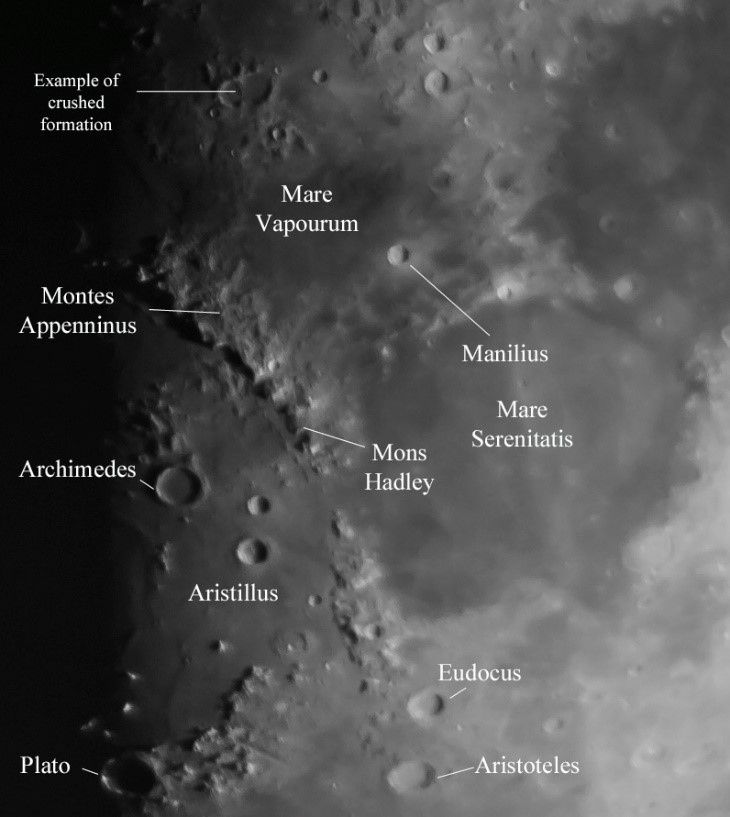
The moon
If you want to see craters on the moon then you need a pair of binoculars, 7×50’s will suffice.
One of the most prominent craters on the Terminator (band between light and dark) is Archimedes, some 50 miles across with crater walls 6,500 ft high, to the south east of this are the Apennine mountains with Mount Hadley near its northern end the site of the Apollo 15 landing was in its shadow.

This is just a taste of the wonders of the night sky. The Broads National Park and North Norfolk coast have some of the darkest skies in England from which to enjoy their beauty.