

Download the route for the Burgh Castle Walk.
What’s it like?
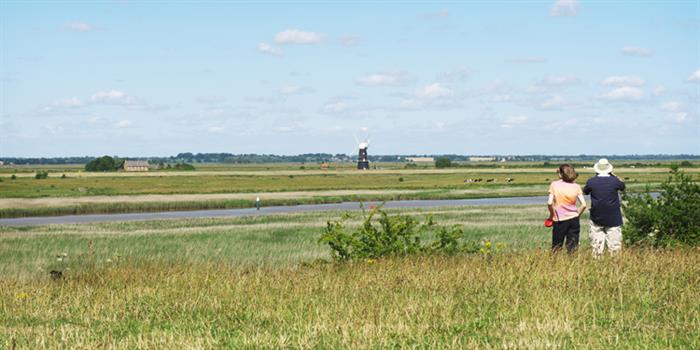
The site offers views over Halvergate Marshes and Breydon Water. You can also see Berney Arms Mill – the tallest drainage mill in the country. Burgh Castle or Gariannonvm is the remains of a third century Roman fort. It stands near the confluence of the Rivers Waveney and Yare before they flow into Breydon Water, the remains of a great estuary. Three walls of the castle remain – the fourth has disappeared into the Waveney. Burgh Castle was built as one of the Saxon Shore forts to defend the coast from Saxon raiders. A long bar of sand and shingle formed across the mouth of the great estuary by about 900, and Great Yarmouth began to emerge.
What wildlife lives there?
The reedbeds below the fort are home to bearded tits, reed and sedge warblers, water rails and yellow wagtails. On the tidal mudflats you can see a variety of wildfowl and waders. Marsh and hen harriers frequent the area in winter.
What else is there to see?
The medieval round-tower church of St Peter and St Paul. If you want to plan some longer walks, the Angles Way long-distance footpath runs through the site and continues to Great Yarmouth, where it links up with the Weavers’ Way and the Wherryman’s Way – the other two long-distance paths in the Broads.
Did you know?
Soldiers at Burgh Castle were part of the Roman army, but they actually came from present day Croatia and Slovenia.